
What Not to Build
Steve Jobs, the Discipline of Subtraction, and the Limits of Focus
Most leadership books tell you what to do. Steve Jobs’s greatest breakthroughs came from deciding what not to do. In the autumn of 1997, returning to an Apple hemorrhaging hundreds of millions of dollars, Jobs eliminated seventy percent of the company’s product roadmap, forcing teams to concentrate on a disciplined four-box matrix. Within a year, Apple was profitable again.
Yet subtraction was never a painless aesthetic gift or easy minimalism. When dogmatically applied without regard for physical laws or user constraints, subtraction led to catastrophic failures: the fanless, overheating 1984 Macintosh; the exquisite $9,999 NeXT cube that academic labs could not afford; and the initial iPhone locked against third-party native applications.
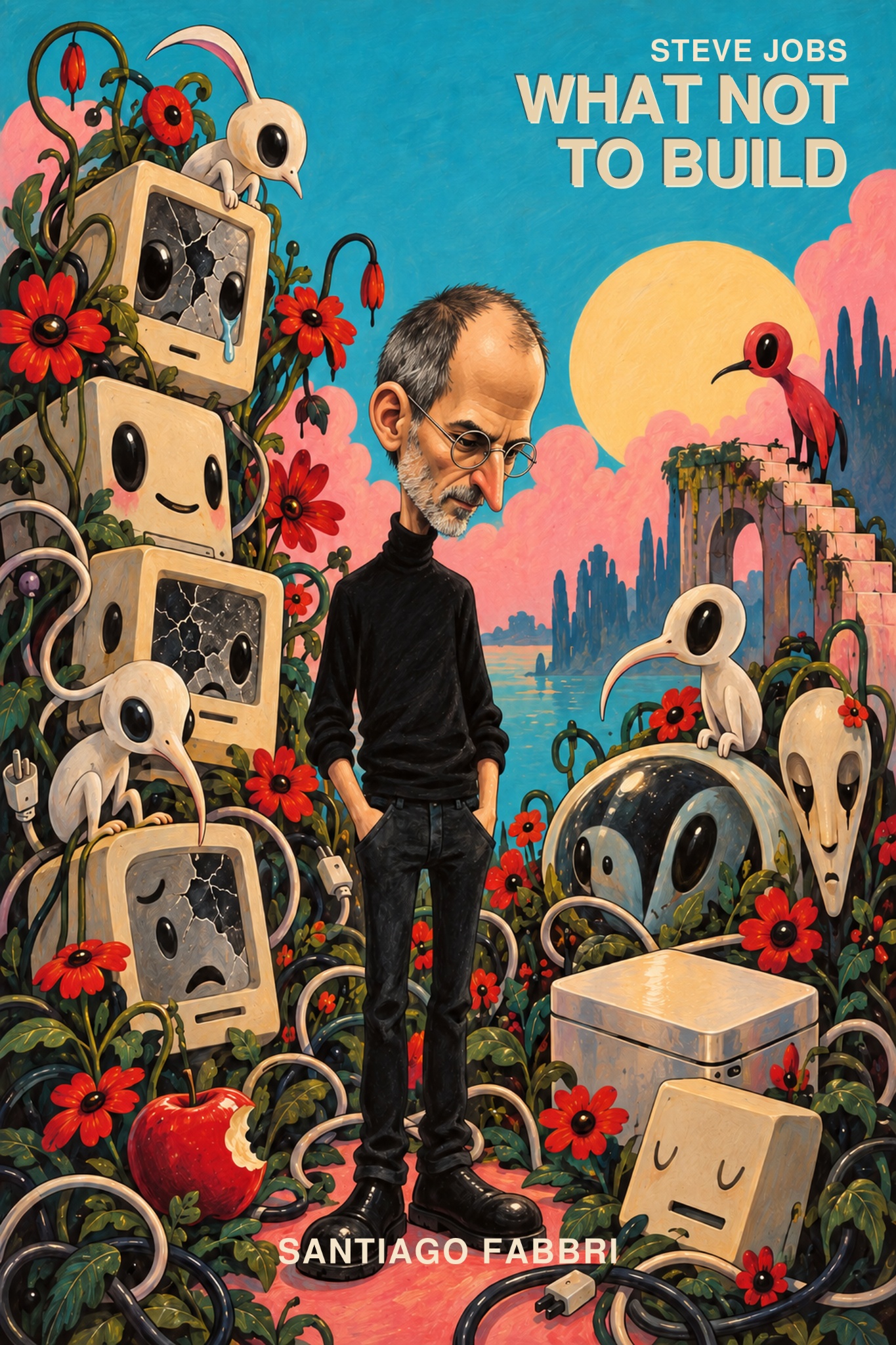
Editorial Scope
The Discipline of Subtraction
How did Steve Jobs decide what not to build, what to simplify, and what to abandon—and what were the systemic costs of subtraction?
Subtraction was not an innate aesthetic gift or easy minimalism; it was a contested, high-stakes intellectual discipline that repeatedly produced breakthrough products alongside near-fatal blind spots. Its power came from forcing teams to solve functional problems without safety valves, but its danger lay in dogmatic refusal of real user and technical constraints until catastrophic feedback forced a pivot.
Drawing strictly on primary corporate filings, engineering patents, recorded design demonstrations, and the testimony of the designers and executives who pushed back—including Steve Wozniak, Bill Atkinson, Ed Catmull, Jony Ive, and Tony Fadell—author Santiago reconstructs the documented decisions of Steve Jobs as a sequence of rigorous historical arguments.
Interactive Historical Rigor
The Five Think Along Pauses
At five crucial decision points, the narrative deliberately halts. Before revealing what Jobs and his teams chose to do, the reader is presented with the raw technical and commercial evidence available in that moment.
The Cold Machine (1983)
Jobs demands that the Macintosh have no fan to preserve quietness. Thermal simulations warn of circuit breakdown. Should Apple add a fan or ship the sealed acoustic pure box?
Jobs refused the fan, insisting that quiet convection through vertical chimney vents was sufficient. When shipped, internal case temperatures regularly exceeded 150°F (65°C), warping diskettes and destroying early 400K floppy drives. Subtraction without thermodynamic respect became the machine’s near-fatal flaw.
The Education of Pixar (1991)
Jobs has poured $50 million of personal fortune into Pixar Image Computers with near-zero commercial sales. Does he shut down the hardware group and cede authority to Catmull and Lasseter?
The Product Cull (1997)
Apple is 90 days from bankruptcy with 15 fractured hardware lines. How do you draw the line between pruning and killing cash cows, and how is the 2×2 matrix enforced?
The Cut of the Floppy (1998)
Every personal computer ships with a 3.5-inch disk drive. Apple readies the iMac with only USB ports. Will retail channels boycott a desktop machine that cannot save files locally?
The End of the Keyboard (2006)
BlackBerry and Palm dominate mobile corporate messaging with physical QWERTY keys. Engineers debate whether glass typing will alienate enterprise buyers entirely.
Manuscript Architecture
Table of Contents
214 Pages · 10 Chapters · Complete scholarly endnotes
The Sealed Box and the Appliance Ideal
The philosophical split between Wozniak’s open slots and Jobs’s consumer appliance.
The Translators of PARC
Stripping the academic three-button mouse and complex menus down to a singular point.
The Cold Machine
The acoustic obsession of the 1984 Macintosh and the consequence of fanless design.
The Thousand-Dollar Cube
NeXT Computer: The magnesium monocoque casing and the cost of uncompromising purity.
The Education of Pixar
Learning non-intervention, executive patience, and narrative discipline from Catmull and Lasseter.
The Great Product Cull of 1997
Eliminating 70% of Apple's roadmap: The creation of the 2×2 product matrix.
The Unbroken Arc
Bondi Blue iMac: Abandoning the legacy serial ports, ADB, and floppy disks.
A Thousand Songs, One Mechanical Wheel
The scroll wheel as algorithmic navigation through deep lists.
Glass, Multi-Touch, and the End of the Keyboard
The gamble of software-defined interfaces: Eliminating physical keys forever.
The Garden Walls and the Limits of Focus
The systemic costs: Monopolies, right-to-repair friction, and the question that remains.
Historical Evidence Base
Selected Archival Sources
What Not to Build is constructed strictly from primary corporate disclosures, engineering patents, recorded design demonstrations, and eyewitness interviews. The manuscript contains over 140 annotated endnotes.
Apple Computer, Inc. Form 10-K for Fiscal Year Ended September 26, 1997
United States Securities and Exchange Commission, Washington, D.C. Archival disclosure documenting the $1.04 billion restructuring charge, inventory writedowns, and official board resolutions executing the cancellation of the Newton MessagePad, Cyberdog, OpenDoc, and QuickTake product lines.
U.S. Patent No. 4,464,652: Display System (Filed March 2, 1982; Issued August 7, 1984)
Inventor: William D. Atkinson; Assignee: Apple Computer, Inc. Primary technical schematics and algorithmic specifications detailing the elimination of the Xerox three-button mouse in favor of a single-button coordinate mapping routine and Region-based graphical clipping.
NeXT Computer, Inc. System Technical Specifications & Magnesium Enclosure Tooling (1988–1989)
Archival filings with Chicago White Metal Casting and Canon Inc. Technical records of the 12-inch magnesium alloy cube monocoque enclosure, 90-degree draft angle milling tolerances, and the 256MB magneto-optical read/write drive integration.
Computer History Museum Recorded Oral Histories: Macintosh Engineering Team (2004–2012)
Archival transcripts and technical debriefs with Rod Holt, Jerry Manock, and Jef Raskin regarding Steve Jobs's insistence on convection-only acoustic silence, and the resulting component failure rates on early Macintosh logic boards.
U.S. Patent No. 7,479,949: Touch Screen Device, Method, and Graphical User Interface (Issued January 20, 2009)
Inventors: Steven P. Jobs, Scott Forstall, Greg Christie, et al.; Assignee: Apple Inc. Archival documentation on the complete elimination of physical hardware keyboards in favor of dynamic software-defined capacitive touch interfaces.
Imprint Colophon
Edition Specifications
Published by Thinking Session Editorial in collector-grade physical editions and synchronized digital formats.
Essays & Field Notes
Essays Expanding This Book
Short field notes and companion inquiries published by Thinking Session Editorial that explore the questions raised in What Not to Build.
How to pressure-test a presentation without over-editing it.
A good rehearsal tests the underlying logic and architecture of the argument before it polishes the slides.
Debriefing high-stakes decisions when the outcome is uncertain.
Separating process quality from pure luck in consequential moments where uncertainty cannot be engineered away.
What to do when every option has a downside.
Some decisions are hard not because the right answer is hidden, but because no alternative is costless.
About the Author
Santiago Fabbri
Santiago is the founder and publisher of Thinking Session. For two decades he has worked in complex corporate environments, leading teams, designing products, and examining the cognitive architectures that govern human decision-making under uncertainty.
His published works include When Machines Answer First, What Not to Build, No Stake in the Outcome, and The Architecture of Attention.