
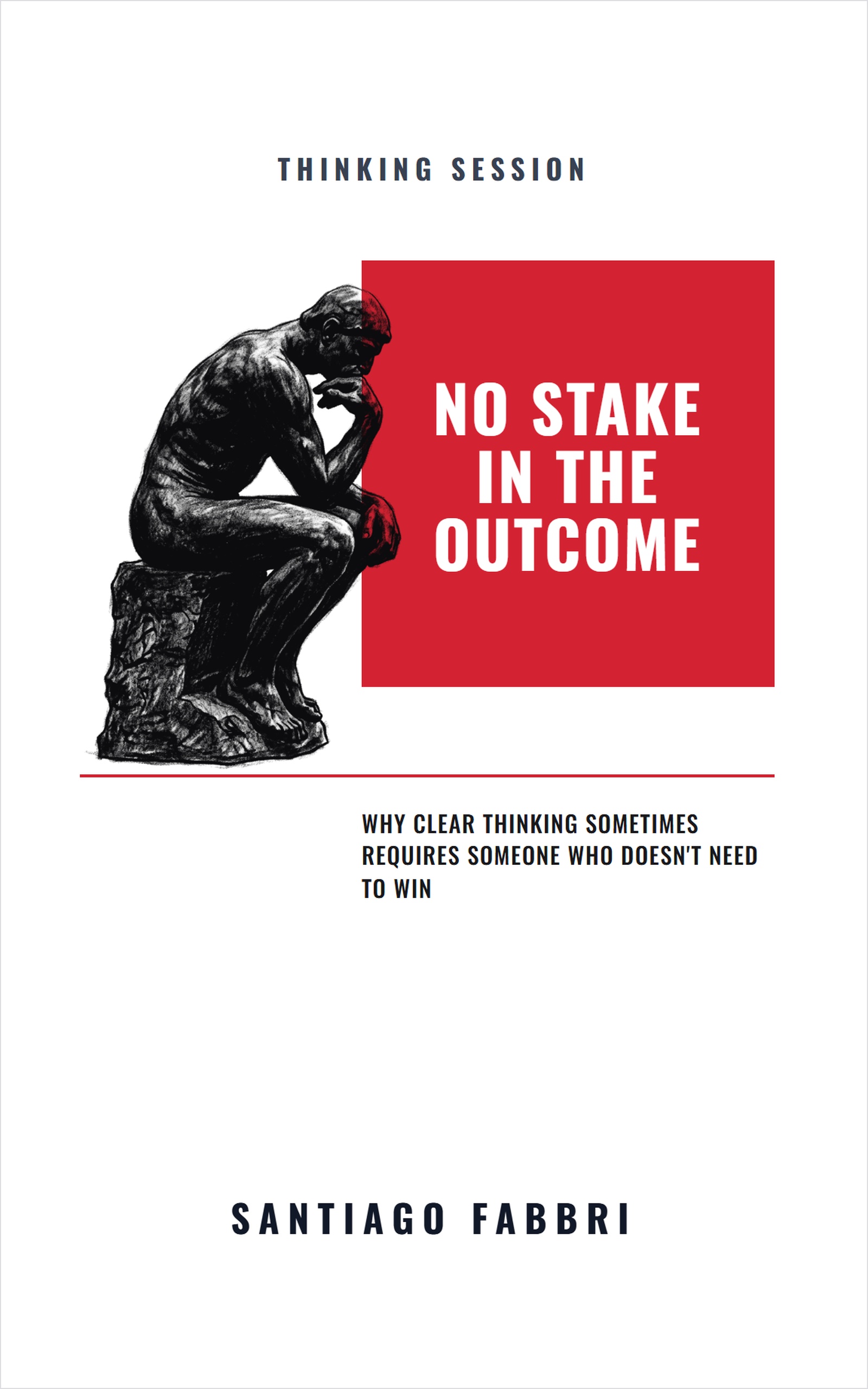
No Stake in the Outcome
Why Clear Thinking Sometimes Requires Someone Who Doesn't Need to Win
People frequently ask for answers when what they actually need is somewhere to think. When advisors, colleagues, investors, or friends have an interest in what you decide, their counsel unconsciously narrows your options. In this foundational book, the discipline of the non-directive conversational clearing is introduced—an intellectual space where your thinking is examined without interference or borrowed agendas.
True epistemic clarity cannot occur inside conversations governed by hidden stakes. By mapping the subtle pressures of fiduciary duty, founder psychology, and the urge to prescribe, this book articulates how sovereign judgment is retrieved when the listener has nothing to win or lose.
Editorial Scope
The Unstaked Clearing
Why does the presence of an interested listener subtly distort the architecture of a leader’s thought?
In any organizational ecosystem, every colleague, board member, and advisor occupies a position that is affected by your decisions. Mentors project past playbooks; direct reports evaluate ideas through workload or safety; boards carry legal obligations. Before a single sentence is spoken aloud, leaders begin self-censoring to avoid alarming the room.
Drawing on cognitive psychology, decision science, and two decades of high-stakes corporate deliberation, this book investigates the conditions required for sovereign reflection. It establishes the non-directive sounding board not as passive listening, but as an active, disciplined architecture for discovering what you actually know.
Interactive Deliberation
The Five Deliberative Pauses
At five critical inflection points, the exposition halts to present the raw cognitive dilemma. Before examining the resolution, the reader must weigh the conflicting incentives.
The Fiduciary Contraction
When your closest advisor holds equity in the outcome, how do you distinguish genuine strategic caution from self-protective risk aversion?
Stakeholders inherently defend existing downside. When advice is given by someone with skin in the game, options that threaten the advisor’s standing are quietly screened out before articulation. True sovereign clarity requires creating a conversational clearing where the listener has nothing to win or lose.
The Curated Dilemma
A CEO senses an unformed threat but knows verbalizing it to direct reports will trigger panic. Where do you speak an unpolished thought when every ear has an agenda?
The Urge to Prescribe
When someone asks you for advice, the psychological pressure to give an answer is overwhelming. Can you resist solving the problem long enough to let them see its true structure?
The Weight of External Consensus
Industry benchmarks and expert panels overwhelmingly favor Option A, but your direct qualitative observations suggest Option B. How much weight should borrowed conviction carry?
Ownership of the Resolve
A brilliant external strategy was handed down by prestigious consultants. In the first crisis of execution, why does imported clarity dissolve into blame?
Manuscript Architecture
Table of Contents
10 Chapters · Complete scholarly references
The Nature of the Sounding Board
Why externalizing thoughts out loud reorganizes cognitive representations.
The Contraction of the Search Space
How advisor stakes subconsciously constrain the boundaries of what is considered possible.
The Ecology of Advice
Distinguishing technical domain expertise from deliberative judgment.
The Curated Dilemma
The psychological toll of leadership isolation and the urge to sanitize problems for audiences.
The Non-Directive Clearing
Designing conversations where the intervener holds zero outcome interest.
The Discipline of Restraint
Why interrupting to solve a dilemma halts the decider’s own synthesis.
Cognitive Externalization
The linguistic transformation of implicit assumptions into explicit trade-offs.
Weight of Advice (WOA) Dynamics
Mathematical models of how humans discount or overweight external recommendations.
Deliberative Ownership
Why execution resilience depends entirely on self-generated conviction.
Sovereign Judgment
Operating with calm intellectual authority when certainty is structurally unavailable.
Imprint Colophon
Edition Specifications
Published by Thinking Session Editorial in collector-grade physical editions and synchronized digital formats.
Essays & Field Notes
Inquiries & Field Notes
Dispatches exploring sounding boards, decision hygiene, and leadership deliberation.
Good Help Should Eventually Make Itself Unnecessary
The final task of good help is to return the choice. Learn how to support clear decisions without creating dependence.
The Answer That Arrives After the Pause
A well-held pause can make room for the answer that polished conversation misses. Learn when silence helps—and when it harms.
The Clues Hidden in How You Explain a Decision
Repetition, contradiction, and surprise can reveal where a decision needs attention—if you treat them as clues, not diagnoses.
A Question Can Be Advice in Disguise
Some questions conceal advice and narrow the answer. Learn how to ask with honest purpose while leaving the conclusion open.
Good Listening Gives Your Thinking Something to Push Against
Listening becomes useful when it reflects the structure of someone’s thinking without interpreting it or taking over the decision.
When More Advice Becomes a Way Not to Decide
Learn when more advice stops improving a decision, how to separate facts from values, and when to stop consulting and choose.
Don’t Take the Decision Away
When someone asks what you would do, the best help may be presence without a verdict. Learn how to support clear thinking without taking over.
Why thinking out loud changes the problem.
Speaking aloud forces cognitive externalization, exposing assumptions that remain hidden during silent thought.
Not every difficult decision needs more advice.
Sometimes the problem is not that you lack opinions. It is that you have accumulated too many of them before identifying what the decision actually is.
Before the difficult conversation.
The hardest part of a professional conversation often happens before the meeting: deciding what needs to be said, what does not, and what outcome you actually want.
About the Author
Santiago Fabbri
Santiago is the founder and publisher of Thinking Session. For two decades he has worked in complex corporate environments, leading teams, designing products, and examining the cognitive architectures that govern human decision-making under uncertainty.
His published works include When Machines Answer First, What Not to Build, No Stake in the Outcome, and The Architecture of Attention.