Editorial Imprint

Books on the architecture of thought, judgment, and minds at work.

Thinking Session is an independent publishing house and editorial laboratory. We produce research-led books and field notes on how people make decisions, direct attention, and choose what to leave out.

New Book Release · October 2026 When Machines Answer First How to Preserve Human Judgment in the Age of AI
The Imprint Bibliography

The Published Works

Each book examines a distinct dimension of deliberation: from the high-stakes discipline of subtraction in product creation, to the perceptual filters, conversational clearings, and cognitive ergonomics required for sovereign judgment in an algorithmic age.

New Release · Nonfiction

When Machines Answer First

How to Preserve Human Judgment in the Age of AI

What happens to human judgment when automated systems answer before we undertake the labor of framing the problem? Today, generative artificial intelligence delivers fluent, authoritative conclusions in fractions of a second. But human judgment is not a downloadable commodity; it is an active cognitive schema built only through the generative friction of unassisted thought. Drawing upon empirical trials in cognitive ergonomics, official aviation safety investigations, and decision science, this volume provides actionable protocols to preserve human judgment in an algorithmic age.

Nonfiction

What Not to Build

Steve Jobs, the Discipline of Subtraction, and the Limits of Focus

Most leadership books tell you what to do. Steve Jobs’s greatest breakthroughs came from deciding what not to do. Reconstructing primary corporate filings, engineering patents, recorded demonstrations, and pushback from designers including Wozniak, Atkinson, Catmull, and Ive, this book investigates subtraction as a contested, high-stakes intellectual discipline producing breakthrough products alongside near-fatal blind spots.

Nonfiction

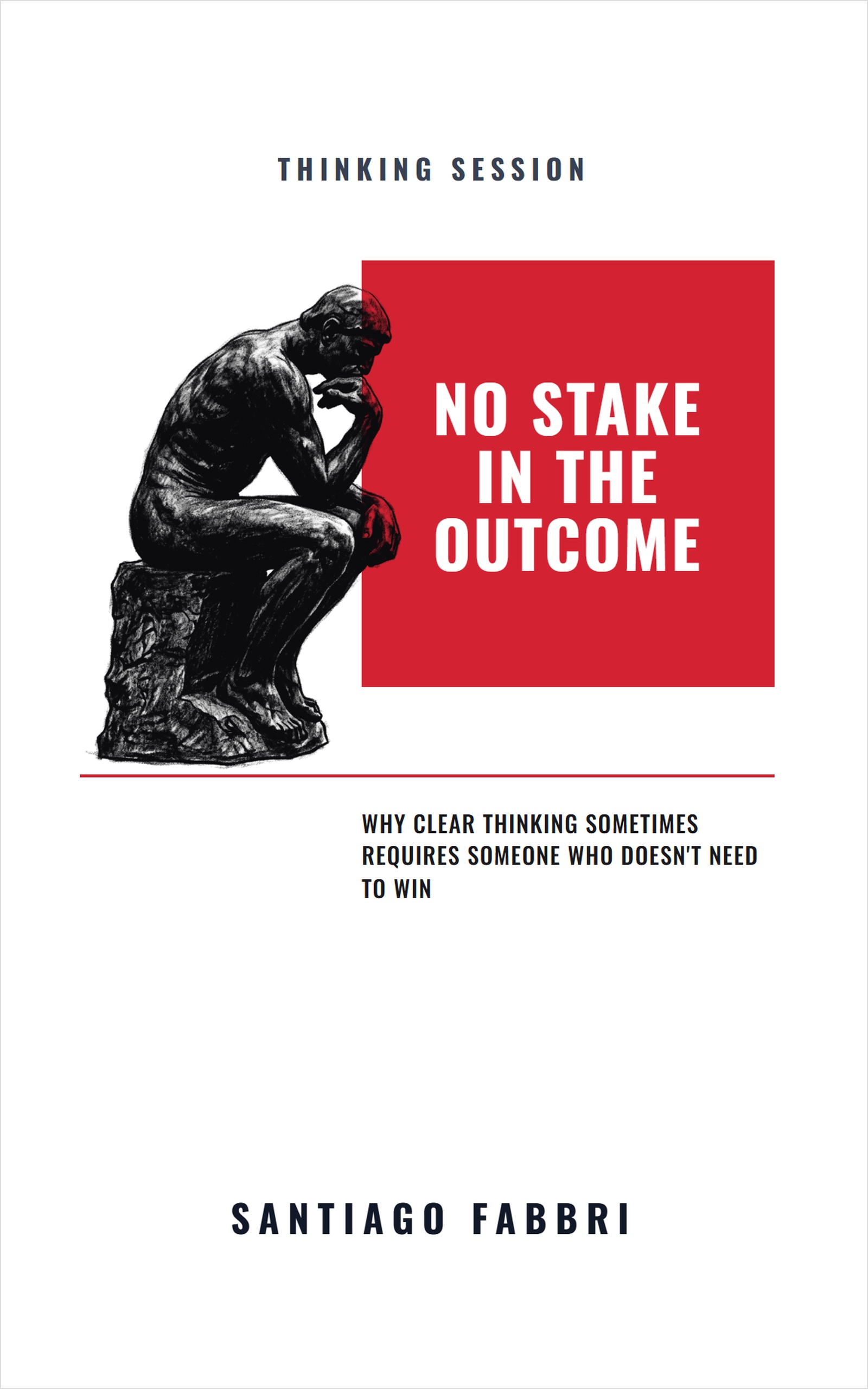
No Stake in the Outcome

Why Clear Thinking Sometimes Requires Someone Who Doesn't Need to Win

When advisors, investors, colleagues, or friends have an interest in what you decide, their counsel unconsciously narrows your options. Santiago introduces the discipline of the unstaked conversational clearing—an intellectual space where thinking is articulated out loud without borrowed agendas, performative certainty, or advice contamination.

Nonfiction

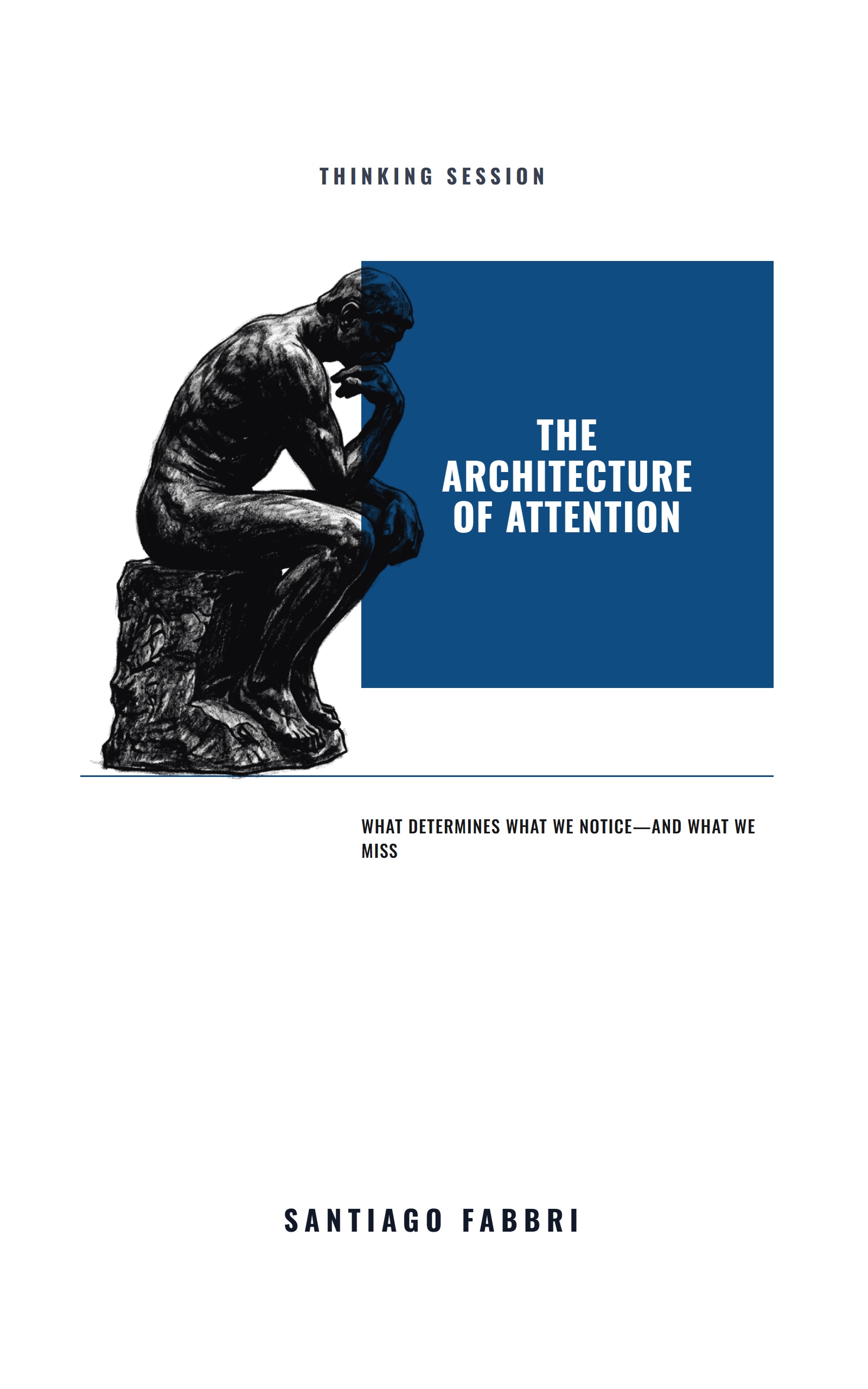
The Architecture of Attention

What Determines What We Notice—and What We Miss

Reasoning is downstream of attention. Perfect logic applied to distorted inputs still produces poor judgment. Moving upstream to the perceptual gateway that precedes all conscious deliberation, this book provides a rigorous framework for diagnosing cognitive blind spots, rejecting manufactured urgency, and reclaiming attentional sovereignty.

From the Editorial Desk

Essays & Field Notes

Articles published by the editorial desk that expand, test, and dissect the underlying questions of our books.

Browse All Essays
The Architecture of Attention

Expertise Needs a Translator, Not More Experts

More expertise can reinforce shared blind spots. Learn how translation turns genuinely different perspectives into usable judgment.

The Architecture of Attention

The Missing Evidence May Be the Evidence

Silence, absent metrics, and missing alternatives can matter—but only with a baseline, recurrence, and a testable interpretation.

The Architecture of Attention

A Hard Stop Can Improve the Quality of Thought

More time can deepen thought—or shelter delay. Learn how decision rules, stop rules, and bounded meetings force useful hierarchy.

The Architecture of Attention

The Reply You Rehearse Is What You Stop Hearing

The moment you compose a correction or solution, you stop hearing the full account. Learn how to postpone response without losing judgment.

The Architecture of Attention

A Closed Door Is a Thinking Tool

Deep thought needs physical, digital, and social boundaries. Learn how to build a credible interval of non-interruption.