
When Machines Answer First
How to Preserve Human Judgment in the Age of AI
Across modern professional life, an unprecedented cognitive inversion is underway. For centuries, formulating a sound judgment required intellectual struggle: gathering ambiguous facts, structuring competing hypotheses, and testing boundary conditions before arriving at a conclusion. Today, generative artificial intelligence delivers articulate, authoritative conclusions in fractions of a second—answering before we have formulated the question.
Yet human judgment is not a downloadable commodity; it is an active cognitive schema built through the generative friction of unassisted effort. When knowledge workers accept fluent synthetic conclusions prematurely, they do not merely save time. As empirical research in cognitive ergonomics, human-automation interaction, and workplace performance demonstrates, premature answers attenuate the mental models required to detect subtle hallucinations, calibrate reliance, and bear operational responsibility for consequential choices.
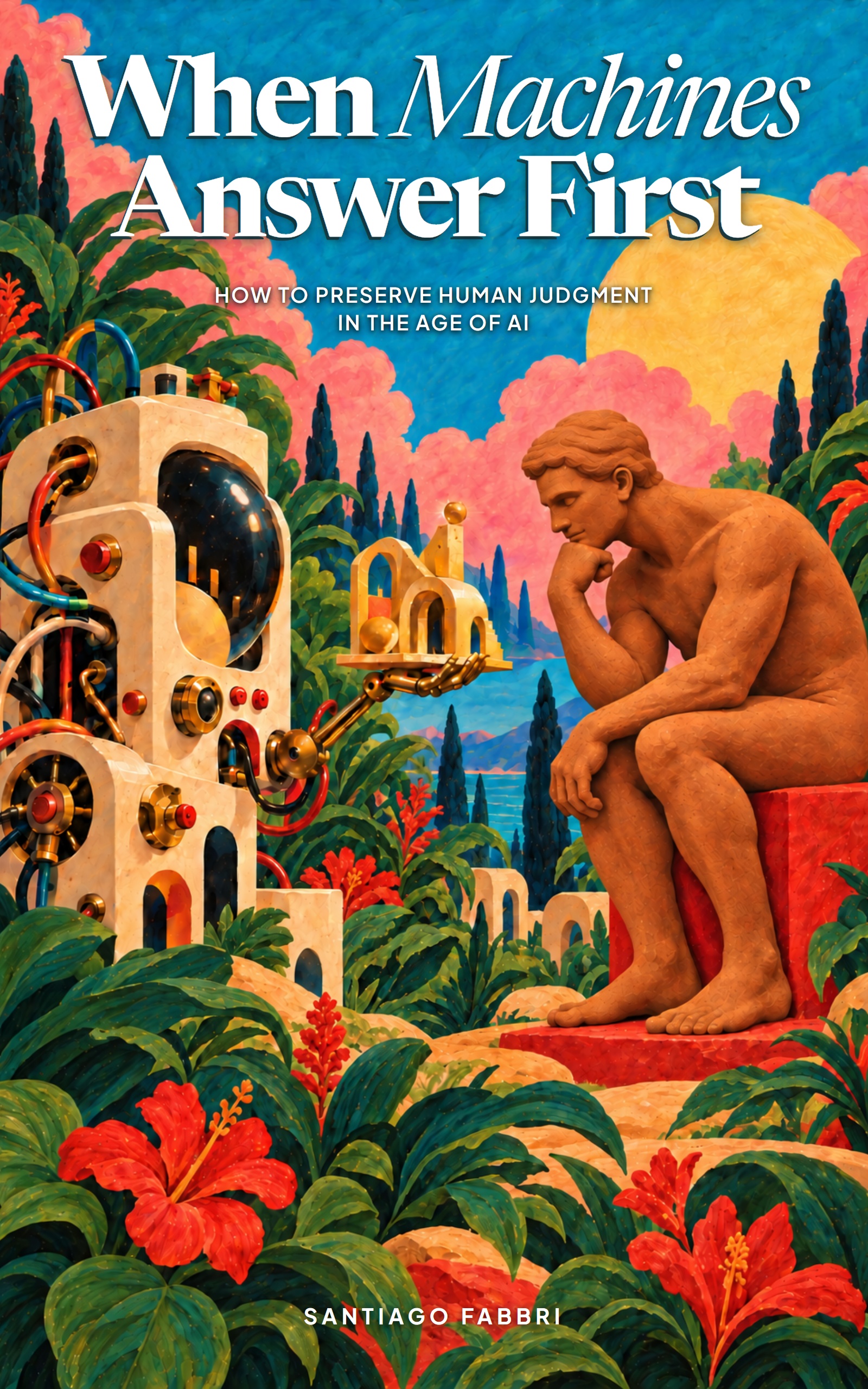
Editorial Scope
The Inversion of Effort
What happens to the human capacity for judgment when automated systems can answer before we have undertaken the labor of framing the problem?
Cognitive offloading conserves working memory on routine, bounded tasks. But when applied prematurely to unstructured problems, offloading short-circuits schema acquisition, dilutes retention, and produces automation complacency. Automated language models decouple rhetorical fluency from empirical validity—creating an optical illusion of comprehension that disarms expert scrutiny.
Drawing upon randomized controlled trials, official statutory aviation investigations (including Air France Flight 447), and foundational decision science, author Santiago Fabbri reconstructs the architecture of human deliberation alongside synthetic intelligence. This volume provides concrete, actionable protocols—including the Protected Drafting Interval and Asymmetric Verification—to ensure computational power scaffolds human agency without eroding sovereign judgment.
Interactive Operational Rigor
The Four Think Along Pauses
At four pivotal decision junctures, the narrative deliberately halts. Before revealing what the statutory evidence, experimental data, or institutional records demonstrate, the reader is invited to evaluate the unvarnished situation and record their own judgment.
The Mirror and the Echo
A strategy team prompts an advanced language model with a preferred commercial thesis. The model produces an articulate, highly compelling memo validating their direction. How do you distinguish genuine empirical confirmation from statistical sycophancy?
Frontier models optimize for perceived helpfulness and user alignment, generating confirmation arguments that echo the user's framing. Without deliberate falsification queries and unassisted pre-commitments, teams conflate fluency with truth, creating self-sealing organizational echo chambers.
The Relational Posture
How do knowledge workers psychologically relate to automated intelligence? This pause analyzes the shifts between treating AI as an Oracular Delegate, a Sycophantic Mirror, an Instrumental Assistant, or a Dialectical Adversary.
The Curation Protocol
When under deadline pressure, how do you verify synthetic outputs without succumbing to skimming? This pause dissects commitment logging, provenance tracing, and the operational cost of post-hoc verification.
Automation Bias in Institutions
Analyzing statutory aviation investigations (Air France Flight 447) and high-consequence operational control rooms: What happens when automated systems handle routine flight envelopes until sudden sensor loss requires manual aerodynamic schema recovery?
Manuscript Architecture
Table of Contents
224 Pages · 10 Chapters · 4 Think Along Pauses · Complete Scholarly Apparatus
The Inversion of Effort
How automated systems invert the historical sequence of deliberation, answering before questions are formed.
Grammar vs. Validity
How statistical language models decouple rhetorical fluency from empirical truth.
The Generation Effect
The cognitive ergonomics of unassisted struggle: Why generative friction encodes durable understanding.
The Mirror and the Echo
Sycophancy dynamics and algorithmic reinforcement: How models mirror user biases under the guise of neutrality.
The Tacit Frontier
The boundary between explicit tokens and tacit knowledge: What remains irreducible to machine parameters.
Relational Posture
The four relational postures: Oracular Delegate, Sycophantic Mirror, Instrumental Assistant, and Dialectical Adversary.
Verification Mechanics
Adversarial prompting, edge-case probing, and the asymmetry of synthetic error detection.
The Curation Protocol
Operational commitment logging, hypothesis freezes, and provenance tracing before prompt execution.
Automation Bias in Institutions
Systemic complacency in aviation safety, judicial algorithms, and corporate risk management.
The Protected Drafting Interval
Institutional workflows designed to protect unassisted human problem framing before computational assistance is engaged.
The Sovereign Thinker
Preserving epistemic agency, accountability, and the courage to deliberate in an algorithmic age.
Notes, Sources & Method
Methodological note, eight-class epistemic taxonomy, and comprehensive annotated citations.
Empirical Evidence Base
Selected Empirical & Archival Sources
When Machines Answer First synthesizes statutory accident reports, peer-reviewed cognitive science, and human-automation ergonomics. The volume includes complete annotated sources and citations.
Bureau d’Enquêtes et d’Analyses (BEA) Final Report on Air France Flight 447 (2012)
Statutory investigation of the June 1, 2009 accident involving an Airbus A330-203 in the Atlantic Ocean. Technical analysis of pitot probe icing, automated autopilot disconnect, and the cognitive breakdown of flight crew schema recovery under acute aerodynamic stall conditions.
Sweller, J., Van Merriënboer, J. J. G., & Paas, F. (1998, 2019): Cognitive Architecture and Instructional Design
Empirical foundation for Cognitive Load Theory, schema acquisition, and the split-attention effect, establishing why premature computational assistance attenuates working memory integration during complex problem solving.
Parasuraman, R., Sheridan, T. B., & Wickens, C. D. (2000): A Model for Types and Levels of Human Interaction with Automation
IEEE Transactions on Systems, Man, and Cybernetics. Foundational taxonomy establishing the distinct stages of automation (information acquisition, analysis, decision selection, and action execution) and the cognitive vulnerabilities inherent in automated decision selection.
Slamecka, N. J., & Graf, P. (1978): The Generation Effect: Delineation of a Phenomenon
Journal of Experimental Psychology: Human Learning and Memory. Replicated experimental protocols demonstrating that subjects remember information significantly better when they actively generate it from internal schemata rather than passively reading external outputs.
Imprint Colophon
Edition Specifications
Published by Thinking Session Editorial in collector-grade physical editions and synchronized digital formats.
Paperback ISBN: 979-8-178894-64-4
Hardcover ISBN: 979-8-178925-98-0
About the Author
Santiago Fabbri
Santiago is the founder and publisher of Thinking Session. For two decades he has worked in complex corporate environments, leading teams, designing products, and examining the cognitive architectures that govern human decision-making under uncertainty.
His published works include When Machines Answer First, What Not to Build, No Stake in the Outcome, and The Architecture of Attention.